
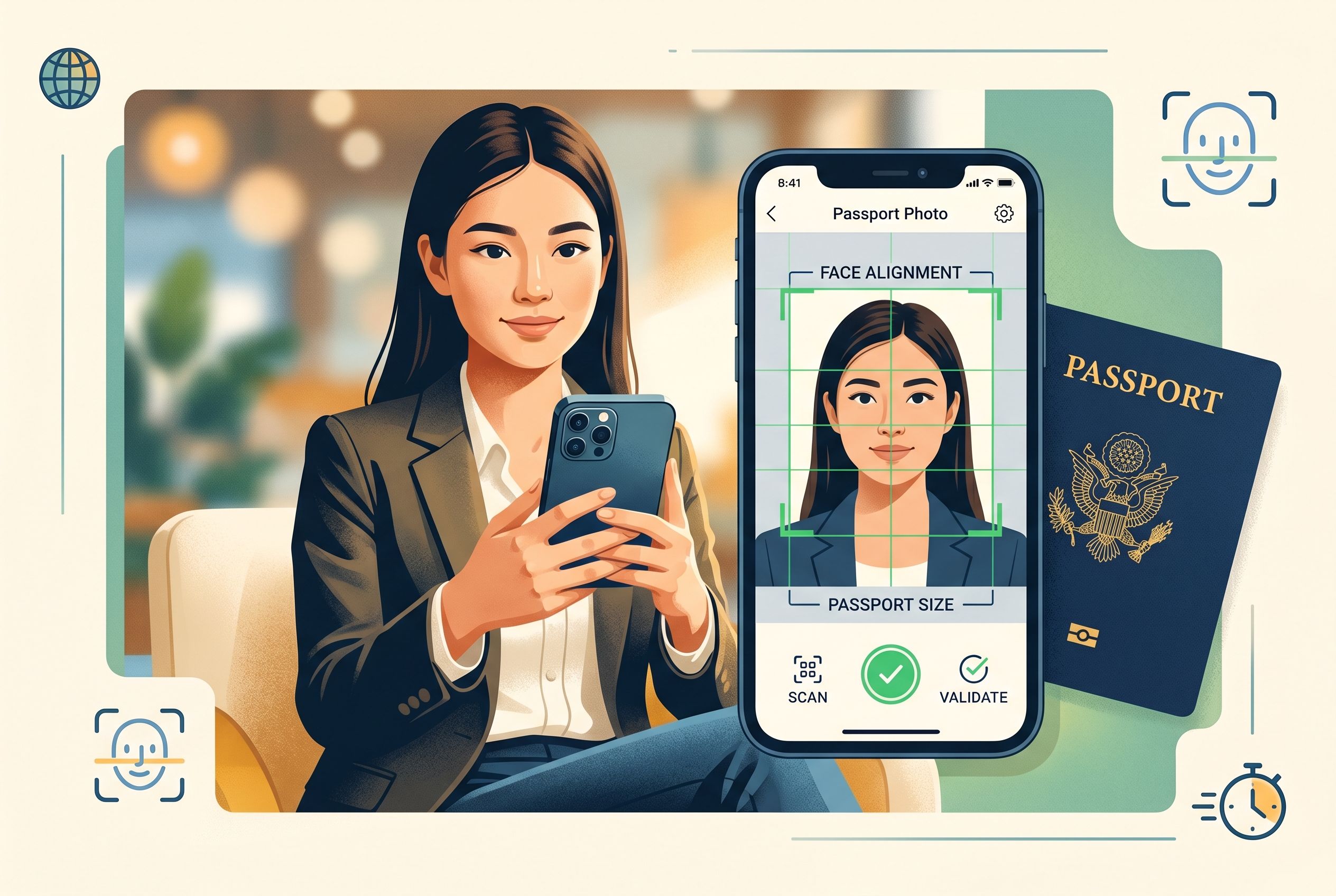
 If you’ve ever had your passport application held up because of your photo, you know how frustrating it can be — but you’re certainly not alone. The U.S. Department of State denied more than 300,000 passport applications in 2024 based on photos that weren’t compliant — and that figure is projected to rise in 2026 as enforcement tightens, the department warned. But what’s more frustrating is that a lot of those rejections came from people who paid for an app to take their photo and ended up with a rejected result.
It’s not that the apps don’t work for passport photos. Some of them are surprisingly good. Where the problem lies is in the mixed-up nature of this category — there are trustworthy apps, but then there are those which are outdated, and which generate photos that look fine to the human eye but don’t pass the automated biometric checks that government systems are now running on every submission. It’s almost impossible to tell the difference from the App Store listing.
That’s what we’re here for. Before we get to the ranked list, it’s helpful to know about the two developments that completely altered the landscape for passport photo app selection in 2026.
The January 2026 Rule Change That Made Some Apps Hazardous
As of January 1, 2026, the U.S. Department of State has eliminated all grace periods for non-compliant passport photos — and imposed an explicit, zero-tolerance prohibition against using images that were enhanced with computer software, phone apps, filters, or AI. That language is more expansive than most people imagine. It doesn’t just mean obvious retouching. It also includes automatic skin smoothing, portrait-mode background blur, HDR processing, and beauty filters — all of which are enabled by default in many popular apps.
Many apps that were still workable in 2024 are now actively working against you for U.S. passport needs. When you submit an image enhanced using any of them, and an automated algorithm detects that it’s been digitally modified, your application is denied outright — without an appeal process for the first review, and without a refund for your fees. Then you have to go back to square one, adding four to six weeks to your timeline.
That’s the context that most ranked lists skip. It’s the difference between which apps make this list and which ones don’t.
What “Compliance” Really Means in 2026 (ICAO ISO/IEC 39794, TL;DR)
All passport photo rules in the world are ultimately derived from ICAO, the UN agency that oversees international travel documents. In 2026, ICAO is in the initial stage of migrating all member countries toward a new biometric data standard — ISO/IEC 39794 — which collects higher-resolution facial data, has narrower head-position tolerances, and requires more exact background luminance.
For practical purposes, this comes down to a small set of non-negotiable rules:
- Your face must take up 70–80% of the photo frame
- The background must be solid white or off-white, with no shadows or faint gradients
- Resolution must be at least 300 dpi
- Your expression must be neutral, and your eyes must be open
- The photo must be unretouched: no filters, no color corrections, no software-based background replacements
That last point is where many apps quietly fail. Background substitution — even if it produces a clean white background — amounts to digital manipulation under current U.S. regulations if it’s done through software rather than against a real white surface. A good compliance-focused app will tell you this. Many don’t.
Before You Download Any App — The 5 Things That Really Matter
Most people judge passport photo apps the way they would any app — star rating, number of downloads, and whether it’s free. Those are the wrong filters entirely. A four-star app with 500,000 downloads can still get your passport application rejected if it runs beauty filters by default or outputs images below the required resolution. A free app that skips compliance verification places all of the risk on you — and the cost of rejection (delayed travel, lost application fees, rebooking flights) is far greater than the cost of any paid tool.
Below are the five criteria used to evaluate each app in this guide, ranked by importance rather than convenience.
- Regulatory Compliance — Is Accuracy Ensured? Do photos produced by the app actually pass government biometric checks — not just “look compliant”? This includes measurements of head-to-frame ratio, background luminance, image resolution, and the absence of digital alteration flags. The best apps offer an explicit acceptance guarantee backed by a refund policy. Apps that claim to provide “compliance checks” using only automated filters — with no option for human review — score slightly lower here.
- Risk of Rejection Apart from compliance accuracy, this asks: does the app do anything that might increase your risk of rejection? That includes applying skin smoothing by default, performing background removal rather than instructing you to shoot against a real white surface, downsampling images below 300 dpi, or failing to warn you about portrait mode. Some apps, unknown to their users, actually increase the odds of rejection.
- Speed to Ready File How long does it take to go from launching the app to having a file you can submit? This matters differently depending on your situation — someone renewing a passport with two weeks to spare has different needs than someone with a flight in two days. This factor encompasses both the waiting time for human review (where applicable) and the photo processing time.
- Print and Digital Options Is the app for digital downloads only, printed photo delivery, or both? A digital file is sufficient for routine U.S. passport renewals filed online. For in-person applications, certain visa applications, and some immigration paperwork, hard copies are required. An app that supports only one format is a partial solution at best.
- Transparency of Charges How much does the app actually cost to produce a final, submission-ready photo — not just to download? Many apps in this category are free to install but charge separately for background removal, watermark removal, compliance checking, or downloading the final file. This criterion measures the realistic total cost of one complete, compliant photo — not the App Store listing price.
Every ranking and comment that follows is based on these five criteria. Visual design, branding, and App Store presentation were not factored in.
Leading iPhone Passport Photo App in 2026 — Quick Answer
If you need a U.S. passport photo from your iPhone that meets current requirements and you’re in a hurry, here’s the quick recommendation: PhotoGov app is by far the best choice for U.S. applicants right now in terms of ensuring exact compliance and providing fast turnaround with clear guidance on what the State Department’s 2026 rules actually mean. It handles the cropping, sizing, and formatting for you — and it doesn’t make the kind of digital alterations that now trigger automatic rejections. For most iPhone users, it is the lowest-risk, lowest-friction option available.
That said, the best app for your situation will depend on whether you need a digital file or prints, whether you’re renewing for yourself or your whole family, and how quickly you need it. The complete ranked list below covers eight apps across those scenarios so you can make an informed choice.
The Right iPhone Apps for Passport Photos, Ranked and Tested
The eight apps below were evaluated across the five criteria described above: Compliance Accuracy, Risk of Rejection, Speed to Ready File, Print and Digital Options, and Cost Transparency. All samples were shot on an iPhone under normal home conditions — artificial light, a plain light-colored wall for the background — to simulate the environment most people will be using. Apps are sorted by overall success rate for U.S. passport submissions in 2026.
#1 — PhotoGov
Compliance: ✅ High | Speed: Fast | Risk of Rejection: Low | Cost: Paid, transparent
PhotoGov is the best overall pick for U.S. passport photos made on an iPhone in 2026. It supports more than 900 ID photo types from over 150 countries, but its U.S. passport workflow is particularly thorough — it walks you through capture with live framing assistance, then crops and sizes the photo to State Department specs without applying any filters or modifications that could cause a denial. The output is a raw, unaltered JPEG that conforms to the latest resolution and dimension standards.
What sets it apart in the current regulatory environment is what it refuses to do: it doesn’t smooth skin, it doesn’t use background replacement as a default fix, and it doesn’t compress the final file to an unacceptable size. For users submitting online renewals who need only a digital file, the turnaround from photo to finished file is under five minutes. Printed photos can also be ordered for delivery. There are no hidden fees and no features locked behind additional payments.
#2 — Passport Photo Online
Compliance: ✅ High | Speed: Moderate | Rejection Risk: Low-Medium | Cost: Paid, transparent
PhotoAiD is a strong contender with a proven compliance track record — it offers a 200% money-back guarantee if your photo is rejected, one of the highest acceptance guarantees in the category. The app guides you through capture, runs an automated compliance check, and then routes photos through a human review step before delivery. That human review is both the app’s biggest strength and its main limitation: it adds time to the process — usually a few minutes, but potentially a couple of hours depending on demand.
The rejection risk is rated slightly higher than PhotoGov because PhotoAiD does perform background removal as part of its process. Digitally altering a passport photo’s background can trigger a rejection under current U.S. regulations — though the human review step is designed to catch and flag issues before you file. For users who have at least a day to spare, the extra layer of review is a reasonable trade-off for the solid guarantee.
#3 — iVisa Photos
Compliance: ✅ Medium-High | Speed: Fast | Rejection Risk: Low-Medium | Cost: Free to use, fee for expert review
iVisa Photos offers one of the cleaner iOS experiences in this category — the interface is stripped-down and simple, there are no ads, and the background removal tool is among the better ones available. Paying for an expert photo review significantly reduces the risk of rejection compared to fully automated solutions. Delivery is available as a digital download or physical print, which covers most use cases.
The caveat is that the free tier is limited. A fully reviewed, guaranteed-compliant photo comes at a price, and the pricing structure isn’t as clear as it should be for first-time users. But if you’re comfortable with a two-step process and willing to pay for verified results, iVisa Photos delivers consistently for U.S. passport and visa photo requirements.
#4 — Passport Photo — ID Photo App
Compliance: ✅ Medium | Speed: Fast | Rejection Risk: Medium | Cost: Free, with in-app purchases
This App Store staple works with 100+ countries and has a large user base, which lends it some surface credibility. The iPhone interface is straightforward — you take or upload a photo, select your document type, crop and adjust, then download. The built-in editor allows brightness and contrast adjustments, which can help correct uneven home lighting — though you’ll need to be careful not to alter the photo so much that it triggers a rejection flag.
The drawback is that there’s no formal compliance guarantee and no human review option. You’re responsible for verifying that the output meets 2026 State Department requirements, including resolution and positioning rules. For low-stakes ID photos, that may be acceptable. For a U.S. passport application — where a rejection means a non-refundable fee and weeks of added delay — the absence of any safety net is a significant gap.
#5 — Passport Photo Creator (Walgreens)
Compliance: ✅ Medium | Speed: Fast (in-store pickup) | Rejection Risk: Medium | Cost: Low
The Walgreens-backed Passport Photo Creator app offers a useful combination: a digital copy plus a printed photo available for same-day pickup at a local store. The app walks you through capture with on-screen instructions aligned to State Department guidelines, then routes the order to a nearby Walgreens for printing. For in-person passport application appointments, this is one of the fastest routes to a physical photo in hand.
The trade-offs are notable, however. The app has limited editing tools, and it doesn’t support digital-only purchases for online submissions. It also provides no compliance guarantee — if your printed photo is rejected at a passport acceptance facility, you’re starting over. It’s most effective as a convenience option for users who already know the photo requirements and simply need a quick, low-cost print.
#6 — Facetune
Compliance: ⚠️ Low-Medium | Speed: Fast | Rejection Risk: High | Cost: Monthly subscription
Facetune is on this list for one reason: it’s one of the more popular tools people reach for when taking passport photos, and one of the most dangerous for that purpose. Its retouching features — skin smoothing, lighting editing, facial feature refinement — are precisely the kind of image manipulation that the U.S. State Department’s 2026 rules prohibit. Using Facetune’s enhancement tools on a passport photo is no longer a gray area; it’s the exact scenario the rule change was designed to address.
The app does have a passport photo option with sizing and background features, and if you strictly avoid the enhancement tools and use only the structural ones, the output can be technically acceptable. But the interface is almost entirely designed to encourage use of those enhancements, and the default workflow applies corrections automatically. Using Facetune for passport photos requires a level of deliberate restraint that runs against the app’s entire design. Most users should look elsewhere.
#7 — IDPhoto4You
Compliance: ⚠️ Medium | Speed: Fast | Rejection Risk: Medium-High | Cost: Free
IDPhoto4You is free, browser-based software accessible on iPhone through a browser — there’s no dedicated app. You upload a photo, crop it using a country-specific template, and download the result. There’s no watermark, which makes it attractive — but the tool doesn’t remove backgrounds, run compliance checks, validate biometrics, or guarantee acceptance in any form. Its own terms of service explicitly state that it bears no responsibility if your photo is rejected.
If you already have a well-lit, properly framed photo taken against a real white wall, IDPhoto4You can handle the final crop and resize competently. If you’re hoping the tool can make a non-compliant photo compliant, it won’t. It’s a formatting tool, not a compliance solution.
#8 — Passport Photo AiD
Compliance: ✅ Medium | Speed: Moderate | Rejection Risk: Medium | Cost: Free with premium tier
Passport Photo AiD sits in the middle of the pack — useful as a secondary option but not a first choice for U.S. passport submissions. It offers a clean, easy-to-navigate interface and solid print delivery options across both web and mobile. Background removal and expedited delivery are included in the premium tier, and the overall experience is accessible enough for first-time users.
The compliance story is less clear-cut than the top three entries. Background removal is available, but as noted throughout this guide, that feature carries an embedded rejection risk under current U.S. regulations unless the result is carefully verified. The free tier also lacks the verification layer that catches problems before submission. It’s a reasonable option for visa photos or international document types with more flexibility — less so as a primary tool for U.S. passport renewals in 2026.
Side-by-Side Comparison: How the Leading iPhone Apps Stack Up
The table below summarizes how each app performs across the five criteria used throughout this article. Rejection risk reflects the app’s default workflow — not a best-case scenario where a careful user manually disables every problematic feature.
| App | Compliance Guarantee | Speed to Ready File | Digital Download | Print Option | Est. Cost (1 photo) | Rejection Risk |
| PhotoGov | ✅ Yes | Under 5 min | ✅ Yes | ✅ Yes | Transparent, paid | 🟢 Low |
| Passport Photo Online (PhotoAiD) | ✅ Yes (200% refund) | Minutes to hours | ✅ Yes | ✅ Yes | Paid | 🟢 Low-Medium |
| iVisa Photos | ✅ With paid review | Fast | ✅ Yes | ✅ Yes | Free app / paid review | 🟡 Low-Medium |
| Passport Photo — ID Photo App | ❌ No | Fast | ✅ Yes | ✅ Via print shop | Free / in-app purchases | 🟡 Medium |
| Passport Photo Creator (Walgreens) | ❌ No | Fast (store pickup) | ❌ No | ✅ Yes | Low | 🟡 Medium |
| Facetune | ❌ No | Fast | ✅ Yes | ❌ No | Subscription | 🔴 High |
| IDPhoto4You | ❌ No | Fast | ✅ Yes | ❌ No | Free | 🟡 Medium-High |
| Passport Photo AiD | ✅ Partial (premium) | Moderate | ✅ Yes | ✅ Yes | Free / premium tier | 🟡 Medium |
A few observations from across the table. Every app with a genuine compliance guarantee — one that’s more than a marketing claim — also includes some form of human review or expert verification in its process. That correlation isn’t incidental: automated compliance checks aren’t sufficient to catch everything that government biometric systems flag, especially under the more rigorous 2026 ICAO standards. The apps that understand this have built human review into their process. The apps that don’t — or don’t care — haven’t.
The split between print and digital options is also worth watching closely for your specific situation. For U.S. passport renewal via the State Department’s online portal, all you need is a high-resolution digital JPEG — no physical prints, no mailing required. Printed photos are still required for in-person applications at passport acceptance facilities and for certain visa or immigration paperwork. Choosing an app that only supports one format when you need the other is a costly mistake.
Finally, cost transparency is more variable than it should be in this category. Several apps present themselves as free and then lock the features that actually matter — compliance review, watermark removal, final download — behind in-app payments that don’t reveal themselves until halfway through the process. The costs shown in the table above reflect what you’ll realistically pay for one complete, submission-ready photo, not the price shown on the App Store listing.
Red Flags to Avoid — Apps That Might Jeopardize Your Application
The ranked list above should give you a solid basis for choosing a tool. This section covers the red flags that should make you walk away from an app entirely — regardless of its star rating, how recently it was recommended in a roundup, or how polished its App Store screenshots look. These aren’t isolated app-specific issues; they’re patterns that appear broadly enough across the category to warrant a dedicated section.
- Default Beauty Filters or Skin Smoothing This is the single biggest hidden rejection factor in the passport photo app space right now. Some apps perform skin tone correction, smoothing, or lighting normalization automatically — sometimes without even labeling it as a “filter.” The U.S. State Department’s 2026 policy disqualifies any modifications made to facial features or coloration. If the output from an app looks noticeably more polished than your original photo, that’s not a feature — it’s a rejection risk. Check the app’s settings before use and disable every enhancement you can find. If those settings aren’t accessible or don’t exist, don’t use the app for a passport photo.
- Background Replacement as a Default Fix Some apps automatically swap out a non-white background for a clean white one when they detect it doesn’t meet requirements. That looks compliant. Under U.S. law, it may not be. The State Department’s guidance is clear that backgrounds must be plain white or off-white as captured — not digitally substituted. The safest approach is to shoot against a real white or light gray wall and use an app that guides you toward that setup upfront, rather than one that treats background replacement as a back-end patch. An app that leads with “Don’t worry about your background, we’ll fix it” is prioritizing convenience over the security of your application.
- Images Compressed Below 300 DPI This one is invisible until it causes a problem — and by then it’s too late. Some free apps, particularly browser-based ones, silently compress images on download to reduce server load or storage usage. The resulting file looks fine on a phone screen, but fails immediately when uploaded to a government portal that enforces minimum resolution requirements. Always check the resolution of any downloaded file before submitting. On iPhone, you can do this by opening the image in the Files app and viewing its details. The minimum standard for U.S. passport photos is 300 dpi; anything lower is non-compliant, regardless of how the photo looks visually.
- No Updates Since 2024 Passport photo requirements tightened significantly between late 2024 and early 2026. Apps that haven’t been updated since before October 2025 were built for a different set of rules — and in some cases, different technical specifications. An outdated app isn’t automatically useless, but it’s unwise to rely on one for a document where a rejection has real consequences. Check the “Last Updated” date in the App Store before downloading.
- No Compliance Promise and No Refund Policy A service that guarantees acceptance — and backs that guarantee with a refund if your photo is rejected — is making a concrete, verifiable claim about the quality of its output. A service that says nothing about compliance outcomes is implicitly telling you that the risk is yours to bear. For a low-stakes ID photo, that may be acceptable. For a U.S. passport application — where the application fee is non-refundable and a denial adds weeks to your timeline — it’s a meaningful distinction. Treat the absence of a compliance guarantee as informative, not just as a missing feature.
- Watermarks on the Downloaded File Some free apps produce a watermarked output unless you pay to have it removed. This one is straightforward: a watermarked photo will be automatically rejected by any passport or visa processing system. It’s worth stating plainly, because the occasional App Store review suggests users have submitted watermarked photos without realizing it. When testing any free app, download the final file and view it at full resolution before deciding it’s ready to submit.
Frequently Asked Questions
Can I take a passport photo with an iPhone in 2026?
Yes — but with more caveats than before. Modern iPhones are capable of producing images that meet passport photo requirements, and the State Department doesn’t prohibit self-taken photos. What it does prohibit, as of January 2026, is any digital processing of the image after it’s been taken. That means disabling portrait mode, HDR processing, and any beauty or Live Photo features before you shoot. You also need to shoot against a real white or off-white background — not let an app substitute one afterward. If you meet those conditions and use a compliant app for cropping and resizing, taking your own iPhone photo is a fully viable path to a compliant passport photo.
What causes a passport photo to be rejected automatically?
Government biometric systems now validate a range of technical and compositional criteria. The most common automated rejection triggers for U.S. passport photos include:
- Head-to-frame ratio that is too large or too small
- Background that is not plain white or off-white
- Shadows on the subject’s face or background
- Eyes that are closed or partially closed
- Detectable digital alterations such as skin smoothing or color correction
- Resolution below 300 dpi
- File not in JPEG or HEIF format for online submissions
Among these, flags for digital editing and incorrect head positioning account for the majority of rejections from app-generated photos, according to independent compliance testing data.
Is a free passport photo app safe to use for a U.S. passport?
It depends on the app and how you use it. Free apps that don’t offer a compliance guarantee, don’t include human review, and have no stated acceptance policy are essentially asking you to assume all the risk — which is defensible if you’re thoroughly familiar with the requirements and shooting under near-ideal conditions. Free tools that automatically apply enhancements, replace backgrounds digitally, or compress the final download below 300 dpi add meaningful rejection risk on top of that. The honest answer is that while free tools can produce compliant photos, doing so reliably requires more expertise and careful setup on the user’s part. For first-time applicants or anyone working against a tight travel deadline, the cost of a paid service is small relative to the cost of a rejected application.
How quickly can you get a compliant passport photo using an iPhone app?
For services that handle everything digitally — capture, crop, format, download — the entire process can take under five minutes from start to finish, assuming your first photo is well-lit and correctly framed. Apps that include a human review step add time: anywhere from a few minutes to a couple of hours, depending on the service and time of day. For physical prints, same-day pickup is available at partner locations such as Walgreens, or delivery in one to three business days by mail. For online U.S. passport renewals, a digital file is all that’s required, making the five-minute end-to-end timeline achievable with the right app.
Are most passport photo apps affected by the AI photo ban that took effect in January 2026?
More apps are affected than most people realize — though not all equally. The ban targets digital alterations to facial features, color, and backgrounds, meaning any app that automatically smooths skin, applies beauty filters, or replaces your background is non-compliant by default. Apps that prioritize compliance over aesthetics — and that guide users toward taking a correct photo rather than fixing one after the fact — are largely unaffected. What this change has effectively done is create a clear dividing line between apps designed to produce compliant images and apps designed to make photos look better. If an app’s marketing focuses on how much more flattering your photo will look rather than how reliably it will pass review, treat that as a signal to scrutinize what it’s actually doing to your image.
What App Are You Actually Going to Use?
The honest takeaway isn’t that one app is perfect and the rest are worthless. The 2026 regulatory environment has raised the stakes of a bad choice significantly compared to two or three years ago — and that means selecting a tool is now a more considered decision than simply picking whatever has the most downloads.
For the vast majority of iPhone users applying for a U.S. passport, PhotoGov is currently the most defensible option. Not because it has the most features or the slickest interface, but because its process is built around the specific compliance requirements that matter in 2026: precise biometric capture, unmodified output, transparent formatting, and clear instructions that reduce the risk of user error leading to a rejection. It handles the technical demands without introducing the digital manipulation risks that have quietly disqualified a number of widely used alternatives. For most people, that combination of reliability and low-friction experience is exactly what the situation calls for.
If you have more time and want the added peace of mind of a human review step backed by a strong refund guarantee, Passport Photo Online (PhotoAiD) is the best alternative — especially for users who aren’t fully confident in their home shooting setup and want an expert to review the final image before submission.
If you need a physically printed photo for an in-person appointment and want fast turnaround, Walgreens Passport Photo Creator serves that need well — just go in knowing that the app doesn’t offer a compliance guarantee, so you’ll want to be familiar with the requirements yourself.
Anything else — older free apps, tools designed primarily for photo enhancement, or apps that haven’t been updated since before these rule changes took effect — is worth reviewing against the five red flags listed earlier before you commit. Getting a passport photo rejected doesn’t just cost you time. It costs you a non-refundable application fee, delays your travel documents, and in some cases disrupts plans that can’t easily be rescheduled.
The tools built around genuine compliance are less likely to produce that outcome. The ones that aren’t are more likely to. That distinction matters in 2026.
For official U.S. passport photo requirements, refer directly to the State Department’s guidance at travel.state.gov.